Share the page
“Climate adaptation should be seen as a pathway, not a collection of solutions,” Christophe Buffet
Published on
Christophe BUFFET Research Officer on Adaptation
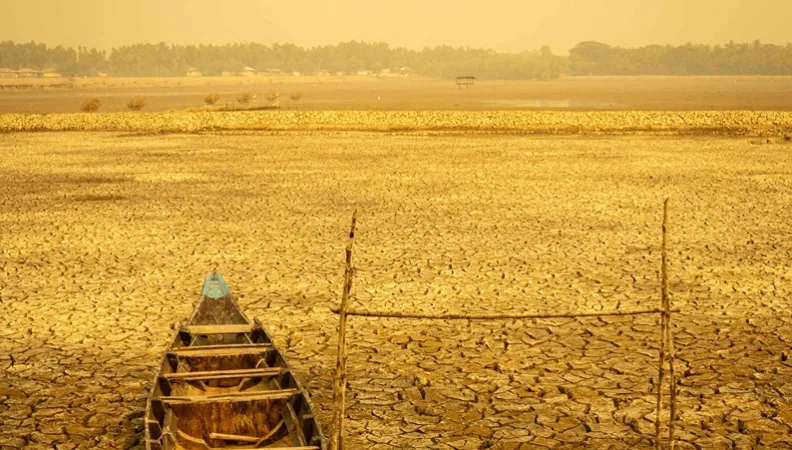
How – and how far – can we still adapt? This is the theme of the 17th International Development Research Conference, organized by AFD Group in Paris on 6 and 7 October 2026 as part of France’s G7 presidency. It will bring together leading researchers, public policymakers, development practitioners, and representatives of international institutions.
Ahead of the conference, Christophe Buffet, a researcher specializing in climate adaptation at Agence Française de Développement (AFD), advocates a more strategic approach to climate adaptation policies.
How can we accelerate climate change adaptation today?
Christophe Buffet: The first priority is finance. According to the United Nations Environment Programme (UNEP), international public finance for adaptation in developing countries fell back to $26 billion – €23 billion – in 2023, while annual needs are estimated at $310 billion to $365 billion by 2035. The quality of financing also matters: despite recent progress, the Intergovernmental Panel on Climate Change (IPCC) finds that funding is often fragmented across small-scale projects, limited to a single sector, and focused on short-term impacts.
The second priority is to view adaptation as a pathway rather than a collection of isolated solutions. We need to combine the right mix of measures, phase them in over time, and identify the warning thresholds at which a strategy needs to change.
How – and how far – can we still adapt? Knowledge and societies responding to the challenges of adaptation
The conference will be held in both French and English, with simultaneous interpretation.
Finally, we need to be able to measure progress. The adoption of the 59 Belém indicators at COP30 is an important step, but putting them into practice remains a major undertaking. They also do not tell us who benefits from adaptation, who is excluded, or even who is adversely affected by it. Qualitative approaches are needed to complete the picture.
For example, the GAP-Track methodology, developed by IDDRI with support from AFD’s AdaptAction program, makes it possible to track and assess adaptation efforts – identifying current and future risks, developing and implementing adaptation plans, and so on – to understand whether they are effective. Through the Track Adapt research project, AFD is now exploring ways to adapt this tool for cities, in partnership with two South African municipalities exposed to climate risks.
Which development programs can offer inspiration on adaptation?
C.B.: AdaptAction naturally comes to mind. AFD has been implementing this program since 2017 in particularly vulnerable countries, focusing on three areas: understanding, planning, and investing. In other words, AdaptAction supports research to better define the scope of adaptation, which evolves over time.
The program supports 20 partner countries in integrating adaptation into every sector, while providing training on the subject and encouraging exchanges between them. This is happening, for example, among several finance ministries in French-speaking Africa. It also helps prepare sound projects by financing feasibility studies. These have led to more than €1.2 billion in projects financed by international funders.
Access to adaptation finance is crucial today, both in international negotiations and on the ground, and AFD Group is particularly well placed to support it. AdaptAction helps strengthen ties between finance and environment ministries, prepare projects for Green Climate Fund financing, and secure direct accreditation to climate funds.
How can science help address these challenges?
Scientific data on changes in the climate and their impacts on regions and economies remain essential. Yet we sometimes assume that better decisions always require new data. In reality, the barriers to adaptation today probably have less to do with a lack of data than with insufficient use of the humanities and social sciences before decisions are made. How should we balance competing uses of water? How do we decide that an area is becoming uninhabitable?
These governance questions cannot be resolved through projections alone. They require new methods for jointly developing solutions and reducing the risk of maladaptation. Some even describe adaptation as a new social contract that needs to be established. Research also helps broaden our sense of what is possible, which is sometimes limited to a list of technical solutions. For example, transboundary risks received insufficient attention until the devastating flood in Nepal in late August made this risk tangible in people’s minds. A recent AFD publication, drawing on the work of the Adaptation Without Borders consortium, proposes a framework for better integrating these risks into climate policies and adaptation projects.
All of this requires exchanges among researchers, practitioners, and policymakers from around the world. That is precisely the purpose of the research conference AFD is organizing on 6 and 7 October 2026 with Sciences Po’s Paris Climate School: How – and how far – can we still adapt?
Useful resources

See also
Serbia and Albania: projects driving closer integration with the European Union
Published on September 14, 2026
Climate change: a MOOC for more sustainable construction in the Mediterranean
Published on September 7, 2026